Showing posts with label Xeriscape. Show all posts

Saturday, October 15, 2011

October Blooms...

One of the gardens I volunteer at as a Master Gardener is the Xeriscape Demonstration Garden....  I helped with the "fall clean-up" earlier this week and couldn't believe how many flowers were still in bloom.--Despite the fact that it's October and we've had little rain and record high temps this summer.

The whole concept of this garden is interesting--it demonstrates the efficient use of water in landscaping. The garden is divided into different zones, each with varying water requirements. The beds that receive no watering at all are still bursting with color due to careful plant selection--tough, drought tolerant varieties...

Since my gardens aren't much to look at this month, I thought I'd share the blooms from the Xeriscape. The fall perennials are exploding with blooms (asters and mums), but there are also annuals still performing, perennials displaying a second bloom and some flowering shrubs and plants that have never stopped blooming!

Annuals...
Dahlia 'Mystic Enchantment'

Dahlia 'Mystic Illusion'

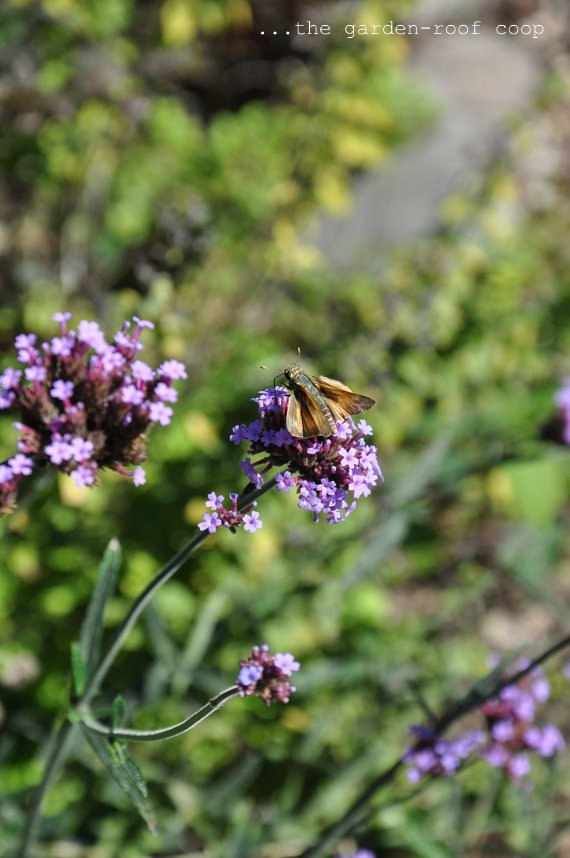
 Verbena bonariensis--Annual, but reseeds...

 Black-eyed Susan Vine--a great annual climber.

 Nicotinana
'Annual Flowering Tobacco' This tall annual reseeds throughout the garden...


Buddleias...

 Buddleia x weyeriina--Butterfly Bush 'Honeycomb'

 Migrating Monarch!

Asters and Mums...


Yarrows--a second boom this season!


For more photos of October blooms, visit the sites:

Thursday, December 23, 2010

2010--The year of the chickens...

 Yes, we put light on the coop this year... I think it looks pretty festive and I'm sure the chicks are appreciative!

I've started thinking about my New Year's goals/resolutions-gardening related-for 2011... At least things that I want to get accomplished before spring-because once it's warm outside then that's where I'll be--outside!

*Plot my gardens:  I have all the plant markers from previous purchased annuals, perennials....  I need to sort through them and either make some kind of a scrap book or an online plot of my gardens...  I would like to be able to link the plants within the blueprint to photos I have taken and info on the plant..and I don't want to pay for any program to do this..  Any ideas are welcomed!

*Volunteer to host my gardens for the spring Master Gardener member tour.  I used to be intimidated by the thought of much more experienced gardeners critiquing my simple set-up, but after attending a couple of the tours I realized that most gardeners do not hire someone else to do the dirty work.  We would rather do it ourselves...Most members have gardens where they planted every seed or start, shoveled out every bed, construced every raised bed and they're proud of their accomplishments.  I know that I would rather tour a homemade garden than one that is perfect and professionally landscaped.  Agreeing to host my gardens will also jump start my motivation to get all the spring cleaning, planting, mulching, sprucing-up that needs to be done!

* Incorporate a kitchen garden theme into my vegetable garden, either by a potager design or just adding more flowers or perennials within the vegetables. I want to add more structure--maybe a trellis or arbor and more color throughout the season--either with flowers or ornamentals.

*Start a booth at the Farmer's Market to sell the living roof birdhouses/feeders and living wreaths that we started making last season.  I devoted a large bed to a variety of sedums and succulents so I should have plenty of starts for this project. I am a little concerned about how much time out of my schedule this will take--I work full time, I'm a mom, etc...  My oldest will be starting college and Grace, my youngest, would be the perfect sales-girl!

* Continue to volunteer at Master Gardener Xeriscape and to begin volunteering at the Dr. Bill Roston Native Butterfly House in Springfield.

*Give the chickens some jobs!  I think a portable chicken tractor is next on the husbands construction list.. Then I would be able to allow the chicks to have a little free range time with the added benefit of eating weeds, bugs--giving me free fertilizer at the same time!  I also want to add a few more hens to the flock.  I should have started out with more, but I had no idea how easy and enjoyable raising chickens would be!

*Honey Bees! Jeff has hinted that he wants to pursue bee keeping and I'm trying to contain my enthusiasm for this venture. I am thrilled--I would love to give honey as Christmas gifts next year!  If I act too excited over this prospect though, he might be concerned that I'll make 2011--The year of the bees!

Merry Christmas and have a Blessed New Year!


View my chicken-blog at communitychickens.com

Tuesday, November 23, 2010

The Monarch--in a class by itself...

I know I'm not the first to be intrigued or in awe of the Monarch.  Just the whole process of metamorphosis - in any butterfly - is a remarkable and a hard concept to grasp.  But the Monarch should be in a class of its own - its lifespan, strength, instincts and beauty set it apart from all the rest.

The Monarch is the only insect that migrates south and hibernates. Each year / season, four generations are born.  The first three generations live about two to four weeks, but the 4th generation migrates to warmer climates in Mexico and California and then returns to North America in the spring, living a total of six to eight months and traveling close to 2500 miles!  Nova had an interesting, informative film, The Incredible Journey of the Butterflies, which details the life-cycle and migration of the monarch - worth watching! It's definitely on my "bucket-list" to some day view the millions (more than 150 million!) of Monarchs hibernating on the Oyamel fir trees in the mountains of central Mexico.

When I first began butterfly gardening, I had no idea how unique the Monarch was... I wanted to include host plants for many of the native Missouri butterflies in my garden, and milkweed, the food source of the monarch larva, was on my list of essential/must-have plants for my garden.   As a side note - eight years ago I had some difficulty finding milkweed locally to purchase. It's almost impossible to transplant our native milkweed, Asclepias tuberosa, - it has a long tap-root and it's late to emerge in the spring which also adds to the problem of being able to identify it before it's too established to dig up and move to another location. I have noticed in the last few years, probably due to the fact of an increased interest and popularity of butterfly gardening, that milkweed is much more available.

It was the second year after I planted the milkweed before I had my first caterpillar, the next year I had several. I've read that the off-spring of the previous year's generations will return to the same milkweed each year. I've also observed that I have had a chrysalis in the same location each year.- In precisely the exact spot: under a garden bench, on a certain branch of golden rod or garden phlox, under the bird bath. This just amazes me - not only does their genetic make-up instinctively direct them across the continent back to my garden, it's passed through their DNA where their ancestors spun their chrysalis!

My garden, in addition to the Master Gardener Xeriscape, are certified Monarch Waystations through Monarch Watch - an organization dedicated to creating, conserving and protecting milkweed/monarch habitats.


Monarch Waystations are places that provide resources necessary for monarchs to produce successive generations and sustain their migration. Without milkweeds throughout their spring and summer breeding areas in North America, monarchs would not be able to produce the successive generations that culminate in the migration each fall. Similarly, without nectar from flowers these fall migratory monarch butterflies would be unable to make their long journey to overwintering grounds in Mexico. The need for host plants for larvae and energy sources for adults applies to all monarch and butterfly populations around the world....Monarch Watch


I've tried to share my admiration and fascination of the Monarch with others - especially children.  It's an easy insect to raise or rear indoors, watch the phases of metamorphosis and then release it to continue its incredible,amazing journey...

LinkWithin

Related Posts Plugin for WordPress, Blogger...